A blog dedicated to the exhibition and book project "Before, During, After: Louisiana Photographers' Visual Reactions to Hurricane Katrina"
Tuesday, February 8, 2011
Before During After Featured In Shelf Unbound
Before During After was the cover feature of Shelf Unbound's December 2010 issue. The article includes several full spreads from the book and an accompanying essay by contributor John Biguenet.
An online preview of the magazine is available here.
Shelf Unbound is a monthly book review magazine featuring the best of small press, university press, and self-published books. Each issue features reviews, excerpts, author interviews, photo essays, and more.
For a complimentary copy of this issue, you can e-mail publisher Caroline Jordan at caroline@shelfmediagroup.com
BDA Earns Mention In Poets & Writers
Before During After was included in the article, Literary New Orleans, Post-Katrina, written by Nicole Cooley and published in the July/August 2010 issue of Poets & Writers Magazine.
Excerpt:
Fiction writer, translator, and playwright John Biguenet articulates this dilemma in an essay he wrote for Before During After, a collection edited by Elizabeth Kleinveld, forthcoming later this year from the University of New Orleans Press. “What conventions exist to depict something that has never happened before?” he writes. “What American novel traces the eradication of one of our cities, the exile of two hundred thousand citizens, the obliteration of a set of intertwined cultures centuries old?...We are only now just beginning to discover what it’s done to us.”
Read the full article here.
Excerpt:
Fiction writer, translator, and playwright John Biguenet articulates this dilemma in an essay he wrote for Before During After, a collection edited by Elizabeth Kleinveld, forthcoming later this year from the University of New Orleans Press. “What conventions exist to depict something that has never happened before?” he writes. “What American novel traces the eradication of one of our cities, the exile of two hundred thousand citizens, the obliteration of a set of intertwined cultures centuries old?...We are only now just beginning to discover what it’s done to us.”
Read the full article here.
Saturday, February 5, 2011
Independent Weekly: BDA Among Noteworthy K+5 Titles
Before During After was included in Katrina, Remembered, Mary Tutwiler's review of five noteworthy new books and documentaries that recall the storm and its aftermath. Published on August 18, 2010, in Lafayette's Independent Weekly.
Offbeat Reviews Before During After
Alex Rawls writes for Offbeat Magazine:
"In the end, the strength of Before During After is the work of the photographers’ work. ...as a collection of photographs, it’s strong, with a few precious visions and a number of remarkable shots."
Read the full review here, published in September 2010.
"In the end, the strength of Before During After is the work of the photographers’ work. ...as a collection of photographs, it’s strong, with a few precious visions and a number of remarkable shots."
Read the full review here, published in September 2010.
Times-Picayune Reviews Before During After
From the book review: UNO Press commemorates K+5 with books 'When the Water Came,' 'Before (During) After' by Suzanne Stouse, published on Sunday, August 29, 2010 in the Times-Picayune.
......

Also from UNO Press, “Before (During) After: Louisiana Photographers’ Visual Reactions to Hurricane Katrina” ($24.95) is another treasure, a beautifully designed book with powerful pictures and essays by 12 area photographers on the ways Katrina refocused their work.
"Before (During) After: Louisiana Photographers' Visual Reactions to Hurricane Katrina," is another Katrina treasure.
How do they see things now? It varies wildly, but examine two snapshots: Jennifer Shaw, who for years photographed urban landscapes, discovered “a wonderful catharsis” after covering the storm’s destruction: telling her own storm story, including the birth of her son on the day Katrina made landfall. No longer shooting “the world around me, documenting things as I found them,” she began working with hand-painted props, setting up her own “tiny worlds” with tiny people (that’s got to be a king cake baby being held aloft by a larger doll’s hands in one shadowy, lovely shot). Frank Relle segued from artful architectural work to taking pictures of homes’ abandonment. His “overriding lesson” is to “get out there and get the picture, no matter what.” During the storm, “if I contemplated photographic concepts before going out into the barricaded Ninth Ward at night, I don’t think I would have made those photographs” -- like the amazing shot of a listing “dollhouse,” a home with its front wall blown off.
Lori Waselchuk bought a panoramic camera, to use not for epic landscapes but “to study details” of the broken city; she is now shooting striking pictures of people in the hospice program at Angola . In a world almost leeched of color by the destruction, Rowan Metzner, the book’s photo editor, moved from making beautiful abstract portraits of the body in black and white to using color -- the better to capture the telling details in pictures of ruined possessions.
With so many arresting images, there’s no such thing as flipping though this book, whose photographs will be featured in a traveling exhibit Sept. 10-Oct. 16. You’re stopped from the start by a cover image of a drowned, disintegrated keyboard by Samuel Portera, who lost his St. Bernard home and darkroom and finds himself now “revealing a more ominous scene”; by the pickets of a drowned fence poking out of the water, a picture by photojournalist David Rae Morris who after witnessing “such suffering and such incompetence” took a break to teach and recharge; by Eric Julien’s beautiful mixed-media collage work, which he turned to “After,” using the few images he had left from a 10-year collection. He says it was therapeutic, but “my work will never be the same.”
On quite the other hand, Jonathan Traviesa, celebrated for his post-storm photo signage in wide-open places, has “resumed work on my long-term projects with new vitality.” “Non-stop” musician portraitist Zack Smith has slowed down, focusing now on inspired character studies of people around him. Mixed-media artist Elizabeth Kleinveld took up photography in order to document the storm’s effects, and concentrates now on producing lovely riot-of-color photographs enhanced to produce a painterly quality. Known for his photographs of “living cultural traditions” – see the fabulous shot of cattle and cowboys moving down a river in a seaworthy pen – Louisiana State Museum system chief photographer Mark J. Sindler now shoots fewer “public rituals and celebrations,” and more “ordinary aspects of life,” his building blocks in “an inclusive visual archive.”
Photojournalist/LSU professor Thomas Neff, who for years pictured people on the country’s rapidly disappearing single-family farms and ranches, turned to photographing Katrina “holdouts,” those who couldn’t or wouldn’t leave the city, a project that would lead to an Ogden Museum show that is now a traveling exhibit. He still visits with those subjects.
In an afterword, John Biguenet, who also wrote the impassioned foreword, calls the photographers witnesses to “a crime for which no has been held accountable.” Louisiana State Museum curator of visual arts Tony Lewis calls them agents of change: “As we internalize these images,” he writes, “and make them part of our individual and collective memory, if we can see them as calls to action, that can make all the difference.”
......
Also from UNO Press, “Before (During) After: Louisiana Photographers’ Visual Reactions to Hurricane Katrina” ($24.95) is another treasure, a beautifully designed book with powerful pictures and essays by 12 area photographers on the ways Katrina refocused their work.
"Before (During) After: Louisiana Photographers' Visual Reactions to Hurricane Katrina," is another Katrina treasure.
How do they see things now? It varies wildly, but examine two snapshots: Jennifer Shaw, who for years photographed urban landscapes, discovered “a wonderful catharsis” after covering the storm’s destruction: telling her own storm story, including the birth of her son on the day Katrina made landfall. No longer shooting “the world around me, documenting things as I found them,” she began working with hand-painted props, setting up her own “tiny worlds” with tiny people (that’s got to be a king cake baby being held aloft by a larger doll’s hands in one shadowy, lovely shot). Frank Relle segued from artful architectural work to taking pictures of homes’ abandonment. His “overriding lesson” is to “get out there and get the picture, no matter what.” During the storm, “if I contemplated photographic concepts before going out into the barricaded Ninth Ward at night, I don’t think I would have made those photographs” -- like the amazing shot of a listing “dollhouse,” a home with its front wall blown off.
Lori Waselchuk bought a panoramic camera, to use not for epic landscapes but “to study details” of the broken city; she is now shooting striking pictures of people in the hospice program at Angola . In a world almost leeched of color by the destruction, Rowan Metzner, the book’s photo editor, moved from making beautiful abstract portraits of the body in black and white to using color -- the better to capture the telling details in pictures of ruined possessions.
With so many arresting images, there’s no such thing as flipping though this book, whose photographs will be featured in a traveling exhibit Sept. 10-Oct. 16. You’re stopped from the start by a cover image of a drowned, disintegrated keyboard by Samuel Portera, who lost his St. Bernard home and darkroom and finds himself now “revealing a more ominous scene”; by the pickets of a drowned fence poking out of the water, a picture by photojournalist David Rae Morris who after witnessing “such suffering and such incompetence” took a break to teach and recharge; by Eric Julien’s beautiful mixed-media collage work, which he turned to “After,” using the few images he had left from a 10-year collection. He says it was therapeutic, but “my work will never be the same.”
On quite the other hand, Jonathan Traviesa, celebrated for his post-storm photo signage in wide-open places, has “resumed work on my long-term projects with new vitality.” “Non-stop” musician portraitist Zack Smith has slowed down, focusing now on inspired character studies of people around him. Mixed-media artist Elizabeth Kleinveld took up photography in order to document the storm’s effects, and concentrates now on producing lovely riot-of-color photographs enhanced to produce a painterly quality. Known for his photographs of “living cultural traditions” – see the fabulous shot of cattle and cowboys moving down a river in a seaworthy pen – Louisiana State Museum system chief photographer Mark J. Sindler now shoots fewer “public rituals and celebrations,” and more “ordinary aspects of life,” his building blocks in “an inclusive visual archive.”
Photojournalist/LSU professor Thomas Neff, who for years pictured people on the country’s rapidly disappearing single-family farms and ranches, turned to photographing Katrina “holdouts,” those who couldn’t or wouldn’t leave the city, a project that would lead to an Ogden Museum show that is now a traveling exhibit. He still visits with those subjects.
In an afterword, John Biguenet, who also wrote the impassioned foreword, calls the photographers witnesses to “a crime for which no has been held accountable.” Louisiana State Museum curator of visual arts Tony Lewis calls them agents of change: “As we internalize these images,” he writes, “and make them part of our individual and collective memory, if we can see them as calls to action, that can make all the difference.”
Before During After: DiverseWorks Exhibition
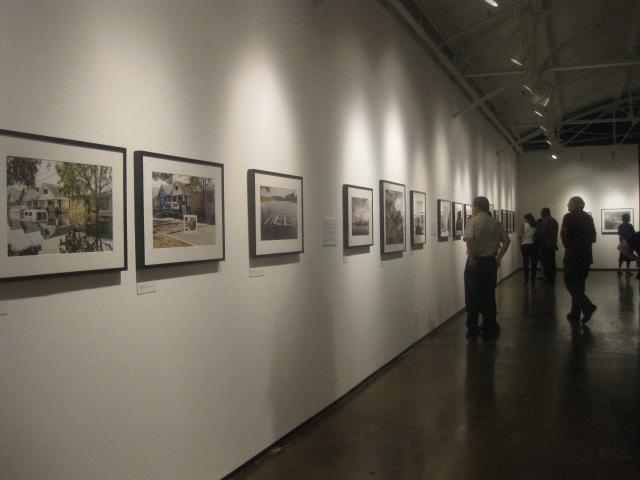
Before During After premiered at DiverseWorks Art Space in Houston, Texas in September 2010, paired with the related exhibition, Under-Standing Water. Here are some installation and opening shots.
Check out this nice listing and slide show, featured on Houston Arts Alliance's artshound.com. The exhibition also garnered mentions in THE BLVD and SpaceTaker's Culture Guide.
Friday, February 4, 2011
Notes from the Symposium: Tracy Xavia Karner
Noted sociologist Tracy Xavia Karner moderated the symposium at DiverseWorks in Houston on September 11, 2010, where Elizabeth Kleinveld, Dr. Tony Lewis, Carl Lindahl and Jan Gilbert discussed the impact of Hurricane Katrina.
Ms. Karner has graciously allowed us to share some excerpts from her introduction.
Sociologists talk about "turning points" in a life: Moments where everything changes... Turning points are instances when you know nothing will ever be --or feel-- the same.
We all have turning points --graduation, marriage, becoming a parent, divorce, loss of someone we love-- so we understand how there are various moments in life where we are called to think about ourselves or our lives in new ways. The life strategies we used in the past are no longer relevant. The expectations we had disappear. Our assumptions are shattered.
Most commonly these are personal--individual moments--where the way things were: what we thought we knew about how life would work out, and who we were, and what we were or were not capable of have changed irreversibly.
Sometimes, however, these moments of transition are historical and shared by many. Some are man-made, like the devastation of war. Others are natural disasters, like earthquakes and hurricanes, while others are a combination of both.
When the turning point event is shared, the expected safety net can disappear. We cannot turn to our friends and family for security, or safety as they are in the midst of the crisis as well. In shared events not only is our own life transformed forever, but everything around us shifts as well.
Yet, it is often at these turning points, that new understandings, new expectations, new ways of being begin to emerge. The casual event opens up a space for exploration that we seldom see or seek while life is steady and predictable. Thus, we begin to try to make sense of what has occurred, and what we will do now.
Telling our story is how we come to understand.
Telling our story to others, and having them as a witness to our transition becomes vital. Some events, traumatic beyond the realm of normal, seem to defy telling.... But the need to tell --to express-- is key in moving beyond the event to ones' new life, ones' new self.
In this instance, creative expression serves as a witness, as an act of healing, and as an act of hope.
"Every word contains a hundred, and the silence between the words strikes as hard as the words themselves. They wrote not with words, but against them."
- Elie Wiesel, Holocaust survivor (Wiesel 1978, p. 200)
"Art may in fact achieve what life cannot."
- Lawrence Langer (from Holocaust Testimonies, 1991, p. 204)
Ms. Karner has graciously allowed us to share some excerpts from her introduction.
***
Sociologists talk about "turning points" in a life: Moments where everything changes... Turning points are instances when you know nothing will ever be --or feel-- the same.
We all have turning points --graduation, marriage, becoming a parent, divorce, loss of someone we love-- so we understand how there are various moments in life where we are called to think about ourselves or our lives in new ways. The life strategies we used in the past are no longer relevant. The expectations we had disappear. Our assumptions are shattered.
Most commonly these are personal--individual moments--where the way things were: what we thought we knew about how life would work out, and who we were, and what we were or were not capable of have changed irreversibly.
Sometimes, however, these moments of transition are historical and shared by many. Some are man-made, like the devastation of war. Others are natural disasters, like earthquakes and hurricanes, while others are a combination of both.
When the turning point event is shared, the expected safety net can disappear. We cannot turn to our friends and family for security, or safety as they are in the midst of the crisis as well. In shared events not only is our own life transformed forever, but everything around us shifts as well.
Yet, it is often at these turning points, that new understandings, new expectations, new ways of being begin to emerge. The casual event opens up a space for exploration that we seldom see or seek while life is steady and predictable. Thus, we begin to try to make sense of what has occurred, and what we will do now.
Telling our story is how we come to understand.
Telling our story to others, and having them as a witness to our transition becomes vital. Some events, traumatic beyond the realm of normal, seem to defy telling.... But the need to tell --to express-- is key in moving beyond the event to ones' new life, ones' new self.
In this instance, creative expression serves as a witness, as an act of healing, and as an act of hope.
***
"Every word contains a hundred, and the silence between the words strikes as hard as the words themselves. They wrote not with words, but against them."
- Elie Wiesel, Holocaust survivor (Wiesel 1978, p. 200)
"Art may in fact achieve what life cannot."
- Lawrence Langer (from Holocaust Testimonies, 1991, p. 204)
Subscribe to:
Posts (Atom)